
By Chris Dowling
Volatility and shifting supply lines are familiar territory in Australian agriculture, and the 2026 season is no exception. While nitrogen management requires a more tactical lens this year, there are clear, practical strategies available to help you stay ahead of the curve. The current landscape doesn’t necessitate a one-size-fits-all approach, but rather a measured audit of your soil N status and a clear-eyed look at your distribution options.
- Assessing the Soil Factory
The first step is knowing exactly what you are starting with. Nitrogen is a dynamic resource, and your soil often holds existing reserves that can significantly offset the need for fresh fertiliser.
- The Soil N Audit: A deep soil test to at least 60 cm is the only way to accurately quantify the mineral N currently in the profile and run an effective N budget.
- The Nitrification Window: Recent warm soil temperatures (20°C–25°C) and moisture events mean biological processes have been active. If you’ve had consistent wetting and drying cycles over the last six weeks, you are likely seeing a significant contribution from mineralisation that must be accounted for.
- Location Matters: It isn’t just about how much N is there, but where it sits. If N is concentrated at depth (30–60 cm) alongside available water, the crop has a reliable reserve for the business end of the season.
- Strategic Allocation: Risk vs. Reward
When supply is constrained, nitrogen should be treated as a high-return asset. This involves ranking paddocks based on their expected response- specifically, the kilograms of grain produced per kilogram of N applied.
| Strategy | Risk | Reward |
| Prioritise Highly Responsive Crops | Lower N available for secondary crops or hay. | Canola often provides a 6:1 to 8:1 return on investment in responsive conditions, even at higher N prices. |
| Redistribution across the Farm | Marginal paddocks may underperform. | Spreading available N across your most reliable paddocks ensures your best land reaches its full potential. |
| Tactical In-Crop Shifts | Reliability depends on late-season rainfall to wash N into the root zone. | Shifting N from pre-plant to Z30 (end of tillering) improves efficiency by matching supply directly to the crop’s peak demand phase. |
- Maximising Efficiency with the 4Rs
If you are applying less total N, you must ensure that what you do apply is utilised with maximum efficiency.
- Placement: Banding N is up to 30% more efficient than broadcasting, particularly in high-stubble environments where surface-applied N can be immobilised by the biology breaking down last year’s residue.
- Timing: For cereals and canola, the window around Z30 is the sweet spot for nitrogen use efficiency. This is also the ideal time for plant tissue testing to ground-truth your soil supply and see if the roots are successfully foraging the N at depth.
- Product Choice: While urea is the standard, alternatives like UAN, sulphate of ammonia, or anhydrous ammonia remain viable. However, remain mindful of logistical trade-offs; lower-concentration products require handling significantly more volume to achieve the same result.
- Monitoring: Plant tissue testing is always a good option to assess whether changes in your fertiliser programs is being reflected in plant performance.
Preparing for the Pivot
Whether you are finalising winter crop top-dressing or pivoting your strategy for summer crops, the goal remains the same: minimise the guesswork.
By using tools like the GrainN plan in Soilmate, we can explore multiple rate options and understand the potential trade-offs for each strategy in a single report. The season ahead doesn’t require a change in the fundamentals of soil science, but it does reward those who use precise data to make measured decisions. ‘Grain N Plan’ in SoilMate simplifies COMPARISON of SOIL NITROGEN SUPPLY and CROP N DEMAND for a paddock under various grain yield and protein targets, as an aid to better N management.
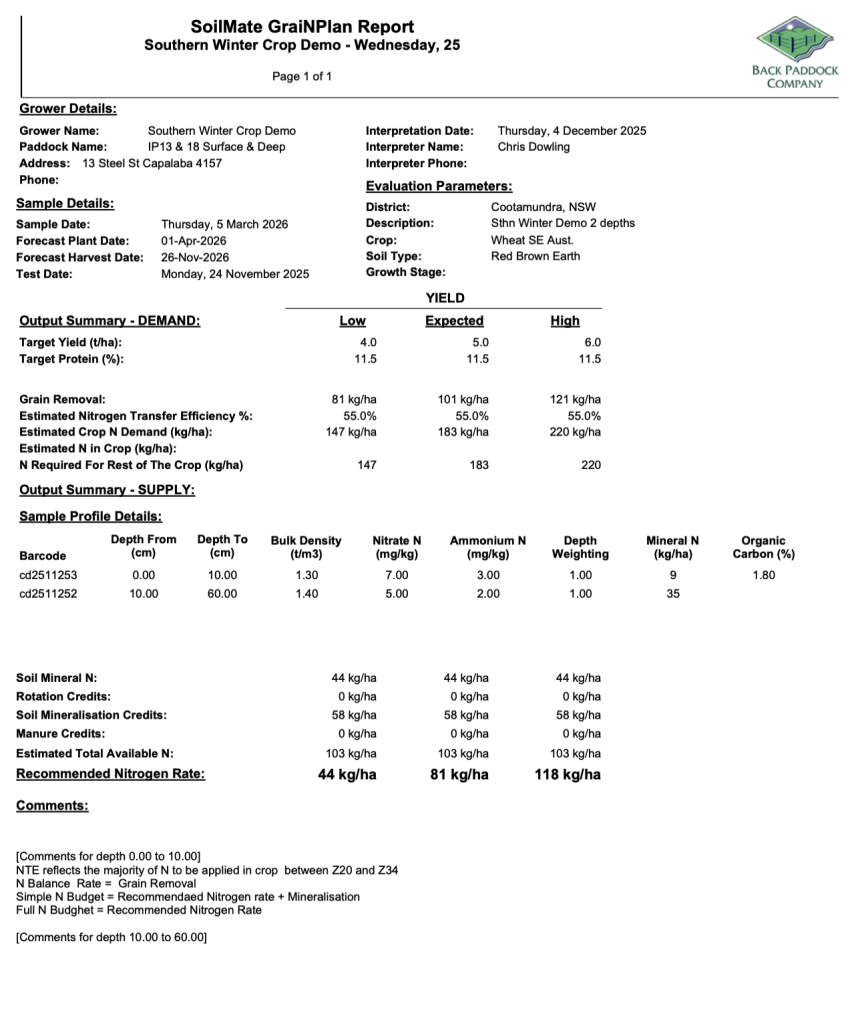
This video steps thru the key parameters input to create this comparison for a paddock/site following receipt of soil test results from a Lab.
As the 2026 nitrogen season unfolds, the most valuable tool you have is a clear understanding of your own paddocks. A simple combination of a deep soil test and a realistic N budget, backed by GrainN plan in Soilmate, can turn uncertainty into a set of deliberate, defensible decisions. If you haven’t already, now is the time to pull your soil data together, run the scenarios, and lock in a strategy that fits both your risk profile and your production goals.